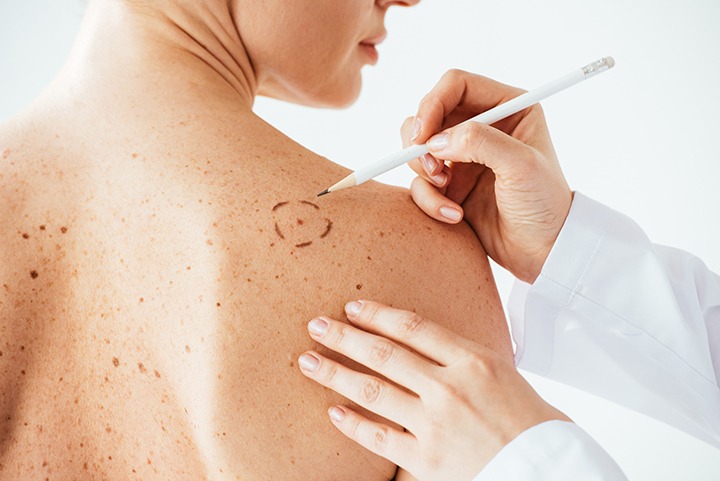
While melanoma is only responsible for around 1% of all skin cancer diagnoses, it can be deadlier because while typical skin cancers stick to one location, melanoma can travel into lymph nodes and even the brain if left untreated, dramatically reducing the survival rate.
Due to that concerning fact, it’s recommended that you perform a melanoma self-exam on a monthly basis and see your dermatologist for a full skin exam on a yearly basis. If you see any concerning signs, check with your primary care physician or a dermatologist for further instructions.
Martine Center for Rehabilitation and Nursing has the details on how to recognize the warning signs of melanoma during your self-exams.
Know What Normal Moles Look Like
A normal mole is evenly colored (usually brown, tan, or black), flat or raised, and round or oval. They typically develop during childhood or young adulthood and look the same for many years. Moles that develop later in life should be examined by a doctor.
Look for Things That Stand Out
In addition to new spots on the skin, watch out for ones that change in size, shape and color. Ones that look different than your other ones should also be checked out.
ABCDE Rule
As a guide when looking for warning signs, follow the ABCDE rule by checking the following characteristics:
- A = Asymmetry. One half of the mole or birthmark does not match the other.
- B = Border. Edges that are irregular, ragged, notched, or blurred need to be checked.
- C = Color. The color of the mole is not the same throughout (different shades of brown or black, or patches of pink, red, white, or blue).
- D = Diameter. The mark is larger than a quarter-inch or 6 millimeters (around the size of a pencil eraser).
- E = Evolving. The mole or birthmark’s size, shape, or color changes.
Also check under your nails, in your mouth, and even in the iris of your eye (the colored part), as melanomas can begin in those areas as well, but it’s more uncommon than on the skin.
If you notice any of these signs, check with your doctor or dermatologist.
To learn more about Martine Center for Rehabilitation and Nursing and all of the services they offer, visit http://martine-center.facilities.centershealthcare.org.